

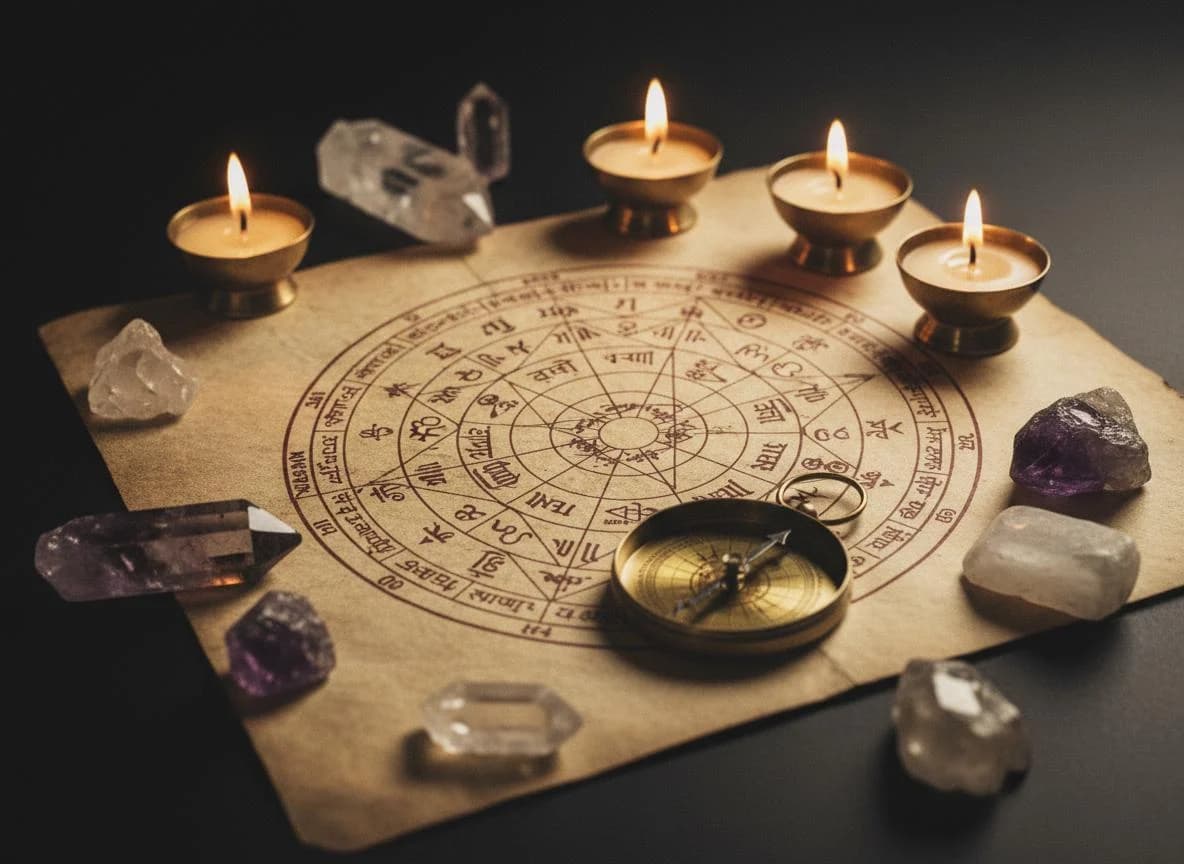
How to Choose the Right Gemstone According to Your Astrology

How to Choose the Right Gemstone According to Your Astrology
Tags: Gemstones, Astrology, Vedic Astrology, Astrology Remedies, Gemstone Guide
How to Choose the Right Gemstone According to Your Astrology
Gemstones have been used in Vedic astrology for centuries as a traditional remedy associated with planetary energies. But choosing a gemstone should not simply be based on your zodiac sign, appearance, or popularity.
In Vedic astrology, the right gemstone is traditionally selected by studying the birth chart (Kundli), the strength of planets, their house placements, and their relationship with the Ascendant.
A gemstone chosen thoughtfully may become a meaningful part of your spiritual and astrological practice.
What Is a Gemstone in Vedic Astrology?
In Jyotish, certain gemstones are traditionally associated with specific planets. The idea is that wearing a gemstone connected with a favorable planet can symbolically strengthen or support that planet's influence in a person's life.
Some commonly associated gemstones include:
Ruby — Sun (Surya)
Pearl — Moon (Chandra)
Red Coral — Mars (Mangal)
Emerald — Mercury (Budha)
Yellow Sapphire — Jupiter (Guru)
Diamond — Venus (Shukra)
Blue Sapphire — Saturn (Shani)
Hessonite — Rahu
Cat's Eye — Ketu
However, this does not mean that everyone should wear the gemstone associated with their favorite or strongest-looking planet.
Why Your Kundli Matters
Your Kundli provides a much more personalized picture than your Sun sign or Moon sign alone.
An astrologer may consider factors such as:
Your Ascendant (Lagna)
Planetary positions
House ownership
Planetary strength
Benefic and malefic influences
Aspects between planets
Current Mahadasha and Antardasha
The overall condition of the planet associated with a gemstone
For example, a gemstone connected with a particular planet may traditionally be recommended for one person but avoided for another because the same planet can have very different functional roles in different birth charts.
Don't Choose a Gemstone Only by Zodiac Sign
One of the most common mistakes is choosing a gemstone solely because an online article says it is suitable for a particular zodiac sign.
Your Moon sign or Sun sign alone cannot provide the complete picture of your Kundli.
Two people born under the same zodiac sign can have completely different Ascendants, planetary placements, Dashas, and life circumstances.
That is why gemstone recommendations should ideally be based on the complete birth chart rather than a generic zodiac recommendation.
Understanding the Major Gemstones
Ruby — Associated With the Sun
Ruby is traditionally associated with Surya, the Sun.
The Sun represents themes such as confidence, authority, vitality, leadership, recognition, and self-expression.
In Jyotish, Ruby may be considered when the Sun has a favorable role in the birth chart.
Pearl — Associated With the Moon
Pearl is traditionally associated with the Moon.
The Moon is connected with emotions, mental patterns, intuition, comfort, nurturing, and the mind.
A Pearl recommendation depends on the Moon's role and condition within the individual Kundli.
Red Coral — Associated With Mars
Red Coral is associated with Mars.
Mars represents courage, action, determination, physical energy, initiative, and competitiveness.
Whether Red Coral is appropriate depends on the functional role of Mars in the person's chart.
Emerald — Associated With Mercury
Emerald is traditionally associated with Mercury.
Mercury relates to communication, learning, analysis, business, intellect, calculation, and adaptability.
Emerald is therefore often discussed in relation to charts where Mercury has a favorable role.
Yellow Sapphire — Associated With Jupiter
Yellow Sapphire is traditionally connected with Jupiter.
Jupiter represents wisdom, learning, expansion, guidance, prosperity, spirituality, and higher knowledge.
Its suitability should still be evaluated from the complete birth chart rather than assumed universally.
Diamond — Associated With Venus
Diamond is traditionally associated with Venus.
Venus represents relationships, beauty, creativity, luxury, pleasure, artistic expression, and material comforts.
The condition and role of Venus in the Kundli are important before considering a Venus-associated gemstone.
Blue Sapphire — Associated With Saturn
Blue Sapphire is associated with Saturn and is one of the gemstones that should be approached particularly carefully in traditional Jyotish practice.
Saturn represents discipline, responsibility, patience, structure, persistence, work, and long-term lessons.
Because Saturn can have significantly different roles depending on the Ascendant, Blue Sapphire should not be selected casually.
Natural, Treated, and Synthetic Gemstones
The quality of a gemstone also matters.
When evaluating a gemstone, consider:
Whether it is natural or synthetic
Treatments and enhancements
Clarity
Color
Cut
Carat weight
Certification
Origin, where relevant
A visually attractive stone is not automatically the right astrological gemstone.
If you are purchasing a gemstone for astrological purposes, ask for reliable information about its authenticity and treatment.
How Is Gemstone Weight Determined?
There is no single universal formula that should be blindly applied to everyone.
Traditional astrologers may consider factors such as:
Body weight
Planetary strength
Ascendant
Purpose of the remedy
Birth chart conditions
The specific gemstone
The important point is that more carats do not automatically mean better results.
The gemstone should be selected thoughtfully rather than simply choosing the largest stone available.
Which Finger Should You Wear a Gemstone On?
Traditional gemstone practices may prescribe different fingers and metals depending on the planet and gemstone.
For example, recommendations can vary based on whether the gemstone is associated with the Sun, Moon, Mars, Mercury, Jupiter, Venus, or Saturn.
The appropriate finger, metal, day, and method should therefore be considered together with the astrological recommendation rather than treated as a universal rule.
When Should You Avoid Buying a Gemstone Immediately?
Be cautious when someone recommends an expensive gemstone without first asking for your birth details or examining your Kundli.
You should also be careful of claims such as:
"This gemstone will definitely make you rich."
Astrology is a traditional interpretive system, not a guarantee of a particular outcome.
A gemstone should be viewed as part of a broader spiritual or astrological practice—not as a substitute for practical decisions, professional advice, financial planning, or medical care.
The Astrochakra Approach
At Astrochakra, we believe that astrology should be approached with clarity, personalization, and responsibility.
Instead of selecting a gemstone simply because it is popular, start with your birth chart.
Your date of birth, exact time of birth, and place of birth can be used to generate your Kundli. From there, the planetary placements and relevant astrological factors can be studied before considering traditional gemstone remedies.
Final Thoughts
Choosing a gemstone is more than selecting a beautiful piece of jewelry.
In Vedic astrology, gemstones are traditionally connected with planetary energies, which is why their selection should be approached thoughtfully.
Before purchasing a gemstone, understand your Kundli, identify the relevant planet, evaluate its role in your chart, and consider the quality and authenticity of the gemstone.
The right gemstone is not necessarily the most expensive gemstone—it is the one that is appropriate for your individual astrological chart.
Explore your birth chart with Astrochakra and discover a more personalized approach to Vedic astrology.